
Why Celebrate Solstice?
This solstice, remember to remember the indomitable grace of Life's Logic

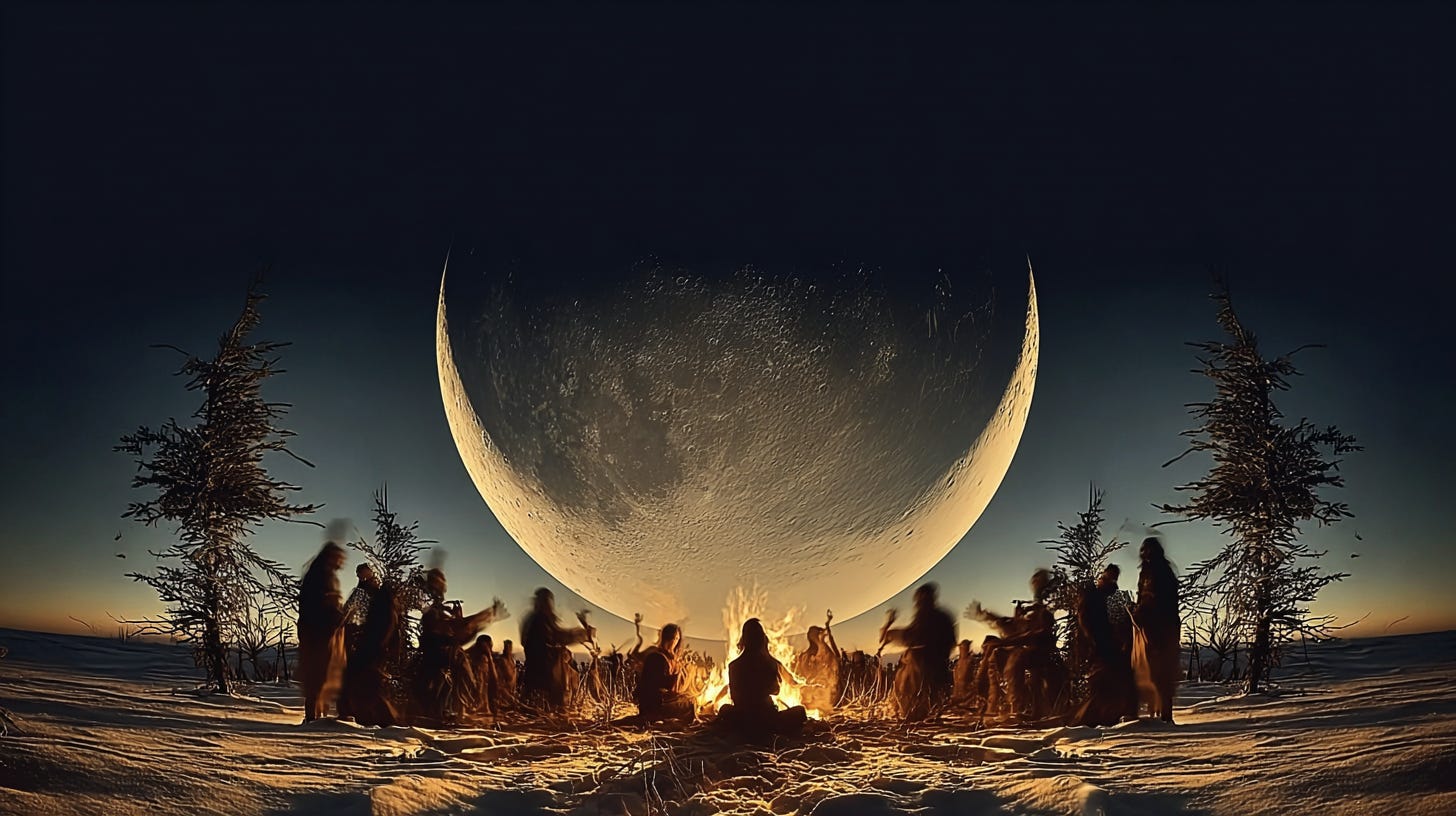
Happy almost Solstice.
December 21st marks the shortest day of the year in the Northern Hemisphere and the longest day in the Southern Hemisphere.
Calculate the exact time of solstice in your timezone here.
Why does this matter?
It’s basic Life Logic.
All of the livingness that makes your life possible — every scrap of food you eat, every breath you breathe, every fiber of your cotton or wool or silk or rayon shirt, emerges out of an interdependent web of natural forces. Life breathes, grows, fruits, decays. All of this happens in a given place that is metabolically bound to season and cycle, currents and hydrology, heat and cold. The indomitable rhythms of Life make your life possible.
Your ancestors knew this.
They knew that darkness brought cold, frugality, the necessity to stick together, and occasional access to profound inner truths. They knew that high summer sun brought heat, ripening fruit, and abundant herds. And, they knew that it was a matter of existential importance to harmonize their lives with these forces, to care for their places. So, they aligned their rituals, harvests, stories, and rites of passage with these bigger patterns. This optimized culture for survival and flourishing.
But these days…
We’re living in a once-in-a-species moment where we’ve completely decontextualized ourselves and our cultures from the ecologies in which we originated. A species separate from the ecology in which it emerged quickly becomes maladaptive, and inevitably will extinct itself.
Pretty moralistic. But true.
Gaia is the moral measure of the veracity of her creations. She measures not according to a species’ capacity for limitless growth or spiritual prowess, but by its capacity to co-harmonize with her eco-logical intelligence over time. She keeps no score—but she does not forget. And those who forget their entanglement with her tend to disappear from her memory.
Can you hear the bio-spiritual call within your own bones to get grounded and re-learn how to co-regulate with your place, your bioregion, your watershed. Can you feel the tug of the cold (or the warmth) to align with the sun’s wisdom?
I know you can.
In the last few years, I’ve noticed a fantastically affirming uptick in people celebrating solstices and equinoxes. This is great news! Perhaps bio-spiritual alignment is instinctive behavior. Attunement to the living, changing world is an adaptive response - one that we are re-membering to remember.
It’s time to re-learn how to track the cycles and systems of nature, and to collaborate with them.
So this Solstice, I invite you to mark the passage intentionally, to align your bodily intelligence with the solar year.
A Solstice Ritual of Seasonal Re-membering
For the shortest day—or the longest, depending on where you stand.
Time required:
15–30 minutes, or as long as you need. You can do this alone or in companionship—with one friend, ten friends, a tree, a bird, or the wind.
1. Step Outside at Sunset or Sunrise and Listen With Your Skin
Don’t start with your thoughts. Let your nervous system meet the moment.
What temperature wraps your body? Is the light thin and slanted, or bright and steady? Where does your skin open and say “yes”? Where does it contract? What other sensations arise? Notice without needing to narrate.
2. Place Your Hand on the Ground—or Something That Calls You
This might be soil, or stone, or an acorn, or your own belly.
Say (silently or aloud):
“I am metabolically bound to this.”
Let the meaning of that phrase ripple out in all directions. Let it echo back into your cells. You don’t need to understand it. Let it reverberate.
3. Breathe With the Season, Not Against It
Breathe in for the darkness. Breathe out for the light. (Or reverse it. Let your body choose.) Let your breath align with what the Earth is doing where you are.
If you’re in the North: the long exhale of descent.
If you’re in the South: the long inhale of emergence.
If you’re near the equator: the steady pulse of balance.
4. Ask: What Is the Season Asking of Me?
This isn’t a prompt for goals or resolutions. This is a relational inquiry.
What is ripening? What is resting? What wants to die or compost, and what wants to root?
Let the questions echo. No need to answer. Let them dance in your dreams.
5. Offer Something Back
A song. A strand of hair. A tear. A seed. A pinch of tobacco. Mark the moment with something un-useful and full of meaning.
Then, Close with a gentle bow, an exhale, or a dance.
To complement the invitation above, I invite you to go deeper into the principle of Hereness. This is one of the 10 rememberings, excerpted from Chapter 6 of my recently published book, True Human, Reimagining Ourselves at the End of Our World.
Hereness
We are here. We are not tourists on this planet, though powerful currents in the last few thousand years of culture have taught us to behave as though we are.
Religion extracted God out of the World; science pulled meaning out of matter; colonization stomped out original cultures of place, eradicating the richness of their memories. Those who resisted were burned at the stake, hunted down, enslaved, converted, silenced. Migrations and forced progress have made us forgetful diaspora.
We have been taught to think of self as something isolated from place and context. It isn’t. (That’s a learned response to trauma.) Self arises in co-regulatory relations with land, people, and more-than-human others. The brain inside your skull infers reality from your contexts and relationships then constructs the mind that perceives the self. The process you call “you” co-arises within a body situated within a place.
Life is a place-based phenomenon. Our bodies are localities embedded within the larger body of the Earth. Hereness is holonic. Your body is the first place, nested within all the other places you occupy: your home, your local ecology and watershed, your bioregion, your country, this planet, this galaxy.
Causality flows to and from here. To have a body is to occupy physical space. It is to be causally entangled with all the places, beings, ecologies, and forces of nature that materially, energetically, and aesthetically co-generate your embodied existence and consciousness. From here, authentic intimacy with other beings and things arises. Place is therefore sacred.
You exist because of the fields of relationships that made (and continue to make) the world you are embedded within. Without these relationships, there can be no self. From this perspective, freedom and responsibility are two sides of the same coin. Because you can’t not be here, this implies responsibility for the contexts within which you can experience and share freedom.
Your body is a sacred place that inhabits various places. It thrives best when you locate yourself in vital kinship with the lands you inhabit. These places thrive when you are intimate with them—when you offer gratitude, walk barefoot, plant seeds, water gardens, swim the waters, hike the hills, learn the songs of birds and cicadas, know the flowers and medicines that grow there, and speak its name as holy. Even in cities, there is life to be met and cared for. Places crave human witness, protection, and co-creation. They like to be asked for permission. They long to be held and tended by true humans.
Our indigenous relatives know these things and construct their ways of knowing in the context of hereness and entanglement. Culture and identity are extensions of ecospiritual communion with the land that makes humans possible. For choice and action to be ethical, they must harmonize with the long-term well-being of the whole.
Separation denies the value of hereness, context, and relationship. The freedom to be, do, and have is paramount. Thus, our behaviors and identities, as participants in a transglobal civilization, have become more and more nonlocal, even anti-local. In Material World: The Six Raw Materials That Shape Modern Civilization, Ed Conway writes: “You can get anything you want from anywhere in the world for a bargain price, but don’t (whatever you do) expect to understand how it was made or how it got to you. Capitalism abstracts commodities from the process of production, standardizes them, and assigns them universal value. Chains of custody are kept intentionally opaque. Desire for information and material goods is met with the press of a button. Yet no manifestation is immaculate. Increased speed implies exponential flows of materials and energy that require extraction and degradation of very real peoples and places.
Our distance from place has soul ramifications. As the natural world dies around us, living places become incapable of remembering us to our belonging within them. They die, just like we do. They forget, just like we do. They grow feeble and senile.
All of our bodies are bound in a shared destiny. You can’t be free in a world that sucks. You can’t be home in a world that is homeless. Or if you can, that freedom and homecoming are vapid shadows of what we are meant to experience through the richness of our belonging to each other and the animate world. We’re all living organisms who are entangled with each other’s bodies and the body of the Earth. Freedom arises in interrelationship. Belonging is unseparate from liberation. In fact, it’s fundamental to it.
How shall we locate in a globalized world? The more nonlocal we become, we must become equally, exquisitely, skillful at placemaking.
We participate in placemaking through embodied relationships. We become denizens of the places we inhabit as we move with and bear witness to the life all around us. We feel the wind on our skin, smell shifting seasons, attend to the sunrise tracking across the horizon from solstice to solstice. We howl with coyotes and greet skittering lizards. We plant a garden then forget to water it. It dies. Then we remember next season. These are gestures of hereness.
My late teacher Dr. Will Taegel described the total, co-becoming intelligences of any given place—inclusive of all human, plant, animal, fungal, microbial, ancestral, mineral, elemental, and technological intelligences, histories, and forces that co-create the suchness of that place—as an ecofield. In his view, skillfulness at sensing, observing, and participating in one’s ecofield was a starting point for respectful belonging. The first time I visited him and his wife, Judith, in the Texas Hill Country, the first words out of his mouth were, “Howdy. Welcome. It has taken this land twenty-five years to learn to trust us.” As we strolled through the cedar forest, he revealed how they had restored the ecology, which had been decimated 130 years earlier by fires settlers had set after they shot all the buffalo. The generational absence of those keystone herbivores and the peoples and natural fire cycles that had collaborated with them had desertified the landscape. Will and Judith had painstakingly pruned acres of gangly, overgrown trees to mimic buffalo moving among them, thus making space for tiny understory grasses to regrow, whose roots channeled rainwater back into the soil. After twenty-five years, the spring at the bottom of the ravine had come back to life! Will and Judith’s story reveals a depth of placemaking we can all learn from.
To locate yourself within your ecofield, become attentive to the histories of what has unfolded there. Who are that place’s original peoples? What happened to them? Are they still here? (Likely they are.) What is the original ecology? Who are the keystone species in that ecology? Who settled in your place? Where were they from? What were they seeking or running from? What did they do to the original peoples? What hunting, ranching, farming, logging, industry, and development did they impose on the land—actions that transformed the flora, fauna, waterways, soil, geography, and cultural landscape of your place? Where does water come from now? Where does waste go? Can you hear the old ones singing?
To root in hereness, begin with observation and interaction. We begin to belong to a place when we know and witness its day-to-day changes. Over time, the mundane becomes sacred through the relationships that reveal themselves as you interact with the world around you. Taking the time to attend to what is literally beneath your feet begins the imperfect repair of that ecofield’s memories of genocide, usury, and despair. Your offerings of witness, gratitude, and grief unwind ancestral trauma embedded in the land. From here, wholeness begins to take root. As you learn, speak the old names, reach out to living indigenous relatives to acknowledge, listen, apologize, and (if given the opportunity) support reparations and rematriation. As you learn, you may also discover physical ways to restore and regenerate the ecology. This might include removing invasive plants, replanting strips of prairie, unfencing savannahs, building wildlife crossings for roads, restarting traditional indigenous fire management, or bringing beavers back.
Develop body memory of the land you occupy. Make it a practice. Don’t drive or fly. Go only as far as your two feet or a bicycle can carry you. Feel the heat and cold, the changing light. Notice buttressed hillsides, the scent of petrichor after the first rain. Walk the same trail many times in different weather. Or simply sit. Sit in the same spot day after day. Ask permission of the land, the ancestors, the spirits of that place. Make offerings, make prayers, make apologies for layer upon layer of injury and absence. Witness silently. Or speak out loud to fat bumblebees, wheeling swallows, ancient stones, sneaky racoons, dying trees, and animate shadows. Stitch your own energy and agency into the community.
Intimacy with place lives in our bodies. Familiarity arrives with grubby hands, broken fingernails, spring strawberries, and eyes wet with wind and wonder. Love for place is a closeness that can equal any lover. It’s a relationship that can break your heart, tire you out, and bring unimaginable joy. It requires time, attention, appreciation, and availability. To be local is to know and be known, to share and co-create a place’s stories, to be woven into its destiny through care. It is to be a part of its living memory and to engage your powers of preservation to protect and regenerate it. And, if you are persistent and forgiving, you are rewarded with a deep sense of home.
We humans have a place in the ecology of our planet. We are custodians. This isn’t a metaphor. It’s a recognition of the ecological role of a species such as ourselves. It’s the shape of our belonging.
Order the whole book on Amazon, Bookshop.org, or BarnesandNoble.com.
And, please comment and share. I love to hear what my writing instigates in your own life and leadership.
In kinship,
Samantha
Oof, this bit hit hard today: "Our distance from place has soul ramifications. As the natural world dies around us, living places become incapable of remembering us to our belonging within them. They die, just like we do. They forget, just like we do. They grow feeble and senile." Yes. Soul ramifications certainly. This comparison to aging is an intense metaphor; I'm sitting with it. In my own time sitting with and drowning/dreaming/drinking in river places, especially, I've come to understand the ways we've modified them (ditched diked drowned under reservoirs channelized poisoned turned into batteries) as an ANESTHETIZING. Water is life, and waterways should be fizzing popping many-voiced tangles of lives. When we simplify them, we simplify (anesthetize) ourselves in relation to them. My time with them, and with my garden, has made abundantly clear that the good work of giving my life energy back to my home lands and waters--as the ritual you've suggested would do, as many people are trying to do--wakes these places up, which in turn wakes me up, and then we can belong together, for a while (we have to do it over and over and over and over again, and there's plenty of beauty in that).
I do sometimes think, though, about the apparent inadequacy, just in terms of the basic thermodynamics, of giving my (rather feeble) life energy back, when the force that modified these systems, at least in this last century, was the force of a monstrous concentrated shot of fossil fuels--millions of years of life energy distilled to channelize those rivers and take apart those mountains. What's my little contribution of life energy (plus the life energies of the waking up place, to be sure) vs. the millions of years of fossil energy that went into modifying these systems. Some days, not every day, that feels like an impossible calculus. Most days, I'm like, well, but what else am I going to do but stake a claim and do the work? There's no worthier work!
Thanks for this beautiful essay and the invitations in it, Samantha; I'm looking forward to reading your book.